
Energy researchers in Japan have introduced a fresh approach that turns leftover oil inside aging reservoirs into low-carbon hydrogen. Many oil fields continue to hold large amounts of trapped crude after production slows. Usually, this material stays underground because recovering it costs too much. With this new method, the process happens directly inside the rock layers, and the unused oil becomes a fuel source instead of wasted material.
The technique builds on familiar oil-field practices, yet it shifts the goal from extracting crude to producing hydrogen-rich gas. At the same time, it limits surface processing and reduces emissions. Because everything occurs underground under natural heat and pressure, the reservoir acts like a built-in reactor.
How the Process Works
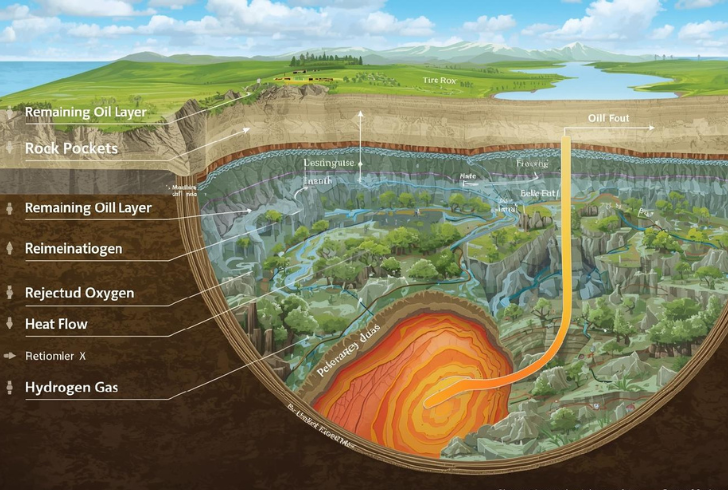
Freepik AI | The underground heat breaks leftover oil into lighter gases and produces hydrogen directly inside the rock layers.
After enhanced recovery operations finish, a portion of oil still remains inside the tiny rock pores. This residue becomes the feed material. Next, specialists inject ultra-fine mineral particles into the reservoir. These particles move through the formation and spread across the remaining oil zones.
Then oxygen enters the reservoir to start a controlled heating reaction known as in-situ combustion. The objective stays very clear: generate intense heat rather than burn away every drop of oil. As temperatures rise, heavier hydrocarbons break apart and create lighter gases.
Soon, these gases react with the natural water vapor already present underground, and hydrogen forms as part of a hydrogen-rich gas stream. Because the transformation happens below the surface, it avoids large industrial reactors and complex facilities.
Minerals That Boost Hydrogen Production
Nickel oxide plays a central role during heating. As temperatures climb, it releases oxygen and strengthens the combustion process. In the process, nickel oxide converts into metallic nickel. This metallic form works as a catalyst and speeds up steam-based reactions, which leads to higher hydrogen output.
At the same time, another mineral solves a major challenge. Faster reactions also create additional carbon dioxide. Since blue hydrogen requires carbon control, the system uses calcium hydroxide to capture emissions at the source. When carbon dioxide forms, it reacts with calcium hydroxide and turns into solid calcium carbonate. This solid material stays locked inside the rock structure, and it does not rise to the surface as gas.
Because the carbon remains underground, the process supports lower-emission hydrogen production. Laboratory tests show that reservoirs with calcium hydroxide produce a higher share of hydrogen compared to systems without it. As a result, residual oil becomes an active energy resource instead of a stranded asset.
High Energy Conversion in Reservoirs
Researchers recreated reservoir conditions in a controlled test environment. They filled a reactor with sand, oil, water, and minerals, and then raised the temperature between 400°C and 800°C. At the higher range, the system reached impressive conversion levels. Up to 70 percent of the original energy inside the oil turned into usable fuels. The gas mixture mainly included hydrogen and methane, both suitable for modern energy applications.
Hydrogen from this process can support power generation, industrial systems, and transport technologies. Meanwhile, methane can operate as fuel or undergo additional treatment when required. Because a significant portion of carbon remains stored underground in solid mineral form, the overall footprint stays lower than standard fossil-fuel pathways.
Compatible with Current Energy Systems
Oil-field operations already rely on techniques such as in-situ combustion and fluid injection. This new hydrogen method builds on that knowledge base, and it aligns with equipment and skills already present in many fields. Consequently, older reservoirs gain new value as energy-transition assets rather than inactive sites.
Additionally, the process reduces the need for large above-ground installations. The reservoir handles high pressure and extreme heat naturally, and the rock layers act as both reaction zone and storage space. In this way, the approach connects legacy energy systems with emerging clean-fuel goals.
Impact on Hydrogen Production
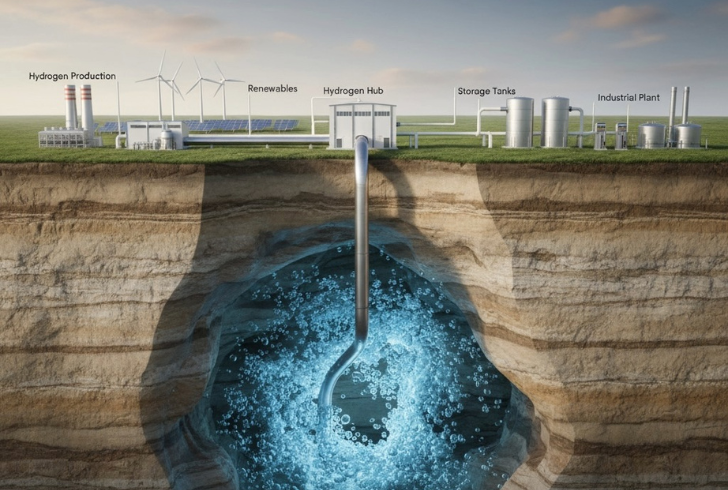
Instargam | @techinergy | Underground hydrogen method could turn old oil fields into clean energy sources.
This underground hydrogen concept highlights a pathway where existing oil fields continue to play a role in cleaner energy development. Instead of discarding unused oil, operators can convert it into hydrogen while locking carbon in stable mineral form. And since the method leverages underground conditions, it helps limit surface emissions and infrastructure requirements.
Across the energy landscape, opportunities like this may support a gradual shift from conventional fuel extraction toward lower-carbon production practices. While research and field-scale testing still need expansion, early results show clear promise.
Turning Residual Oil into Clean Energy
In many regions, mature reservoirs still contain significant trapped oil that no longer holds economic value in traditional markets. With this approach, that material gains new relevance. The method increases hydrogen output, reduces released CO₂, and keeps most of the transformation below ground.
As research progresses, the concept may reshape how aging oil fields operate. And with each improvement, residual oil moves one step closer to becoming a reliable hydrogen source rather than an overlooked resource.
The findings show how innovation can repurpose existing assets, and they point toward a cleaner direction for future fuel strategies.